

If I Only Had One Bed
Here's exactly how I'd use it in zone 7a

I’m fortunate to have a larger garden and enough time to care for it, but I know most people are working with less space and tighter schedules. Even so, a smaller setup can produce far more food than people expect.
With one 8x4’ bed, it’s possible to harvest substantial amounts of organic vegetables and herbs across spring, summer, and fall, and even into winter with a cold frame. So if I only had space or time for one bed, here’s exactly how I’d use it.
A simple strategy:
Spring: A wide variety of greens, herbs, and root crops
Summer: High-yield fruiting crops
Fall: Cool weather loving, quick turnover crops
Winter: Organic mulch cover, cold-framing, or cover crop
I’d take advantage of vertical space and, where possible, let a few plants sprawl beyond the bed edge.
At-a-glance calendar (e.g. zone 7a)
Mid-March to May
Direct sow: Arugula, spinach, endive, leaf lettuce/mini romaine, radish, cilantro, parsley, green onion, and early maturing carrots.
Harvests*: Radishes harvested first (25 days), greens and cilantro next (40-50 days), carrots (55 days), and then green onions, endive, and parsley (70 days).
Mid-May to September
Transition to: Cucumbers, paste tomato, bush green beans, basil, zucchini, and one productive pepper. French marigold and nasturtium interplanted.
Harvests*: Green beans, zucchini, and cucumbers first (55 days), then peppers and basil (65 days), and then tomato (70 days).
September to Frost
Sow: Turnip, beet, radish, carrot, pac choi, arugula, spinach, and leaf lettuce.
Harvests*: Radishes first (25 days), then greens (starting ~30 days), then turnips, carrots, and beets (55 days), and then pac choi (60 days).
Winter
Cold frame: Winter density lettuce, spinach, kale, beet, leek, and carrot.
Harvests*: Most of these cold-framed crops can be picked slowly throughout winter, starting earliest with spinach (~40 days).
Cover: Buckwheat, oats, and field pea, or an organic mulch like leaves, compost, or straw.
*Days above are approximate and depend on variety, temperature, and weather. Days to harvest are from direct sow excluding tomato, pepper, parsley, and leek which are typically counted from transplant date.
The One Bed Plan
Before getting into it, I have a couple of notes on bed placement.
First, the crop choices above reflect the ability for my bed to receive full sun (8+ hours daily). All fruiting crops like cucumbers, tomatoes, and peppers need full sun to produce good yields, so it would be necessary for my bed to be placed in an ideally south-facing area with unobstructed sunlight for most of the day. If I didn’t have access to such a location, I would make many changes to my selections.
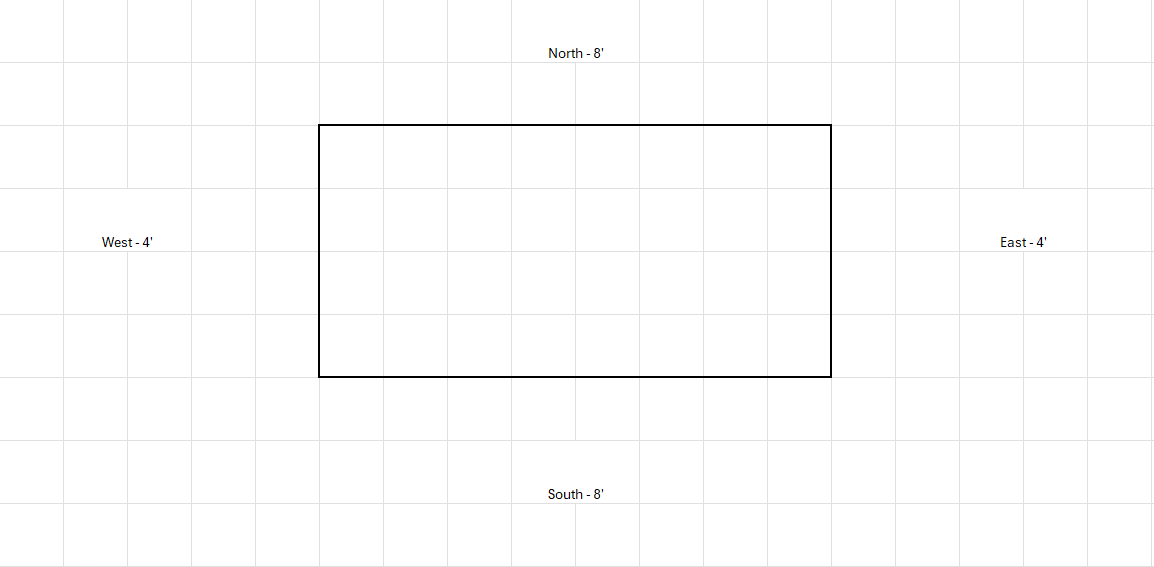
Second, the crop listings above also reflect the option to orient my bed east to west lengthwise, so that the north side of the bed is 8’ long, and the east and west ends are 4’ each. Likewise, if I was forced to orient the bed north to south lengthwise, I would need to alter my selections, however the impact from this would be less substantial than it would if the bed didn’t get full sun.
Spring (Mid-March to May)
In the spring, I’m looking forward to eating a variety of crisp greens from my garden. I’ll utilize the majority of my bed to plant arugula, spinach, endive, leaf lettuce and/or mini romaine heads, but I’ll leave room for radishes, cilantro, one parsley plant, green onions, and some carrots.
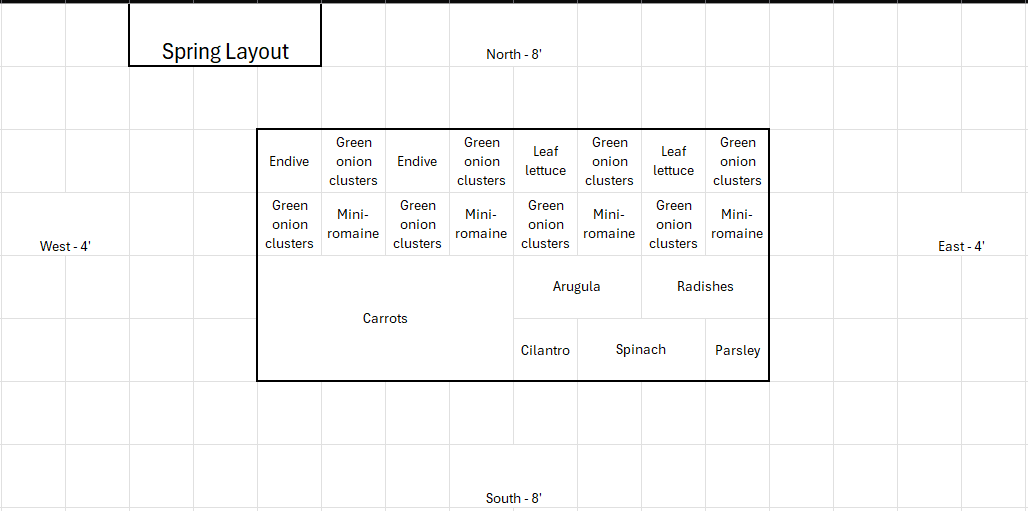
Taking height and access to sun into consideration, I put the shortest crops on the south side, and the tallest on the north side of my bed. The exception to this rule is the parsley, which I’ve put in the southeast corner because it will be staying there all year and will end up being one of the shorter plants in the summer.
Interplanting the green onions in with the greens will work well, I think, because green onions require less sun, do very well growing close together, and might have some pest-deterrent effects that would benefit the tender greens. For those, I’d sow five clusters of about a dozen green onions in each square foot.
I decided to put the carrots on the other side of the bed from the parsley because they are from the same family, so I want to make sure if there is a problem with my carrots that it doesn’t migrate too easily to the parsley and vice versa.
Excluding the parsley, endive, and lettuces, these spring crops can be grown relatively densely. Radishes only require 1” spacing, so even though 2x1’ of radishes may not sound like a lot, it’s technically possible to grow up to 288 radishes in the allotted space at once in a grid formation. I’m going to be a little more realistic with the numbers, because I think we all know we can’t rely much on technicalities.
For a few reasons, I can’t plant the true maximum number of plants in their allotted spaces. A perfect grid of radishes or carrots or anything isn’t possible (i.e. I’m human), it’s not feasible to plant right up against the edges of the bed, and there will be spillover from each crop into the space of the neighboring ones.
However, if I want to have as many carrots as possible, for example, I might plant the max number of carrots and then reduce the number of green onions, cilantro, and arugula that border the carrot allotment so there is less crowding and overlap.
To boost the output from this spring bed, I would succession sow radishes, spinach, cilantro, and arugula once every 7 days for the first few weeks of spring.
Maximum potential output:
2 heads endive
2 heads leaf lettuce
4 heads mini-romaine
250-400 green onions
90-100 carrots
12-18 arugula plants
60-90 radishes
12-18 spinach plants
6-10 cilantro plants
Parsley (may not be ready to pick yet)
Toward the beginning of May, gaps will begin to show up, which is when I’d start to replace the spring crops with my summer fruiting crops and companion flowers.
Summer (Mid-May to September)
Of all the summer crops, the highest-yielding and most desirable foods in my house are tomatoes, peppers, beans, and zucchini. We also use a lot of basil and parsley, so those will come in handy as the season progresses. I’ve included marigold and nasturtium in the summer bed to draw in pollinators, but also to ward off pests, serve as a trap crop (nasturtium), and to bring in more beauty and color (and fun!).
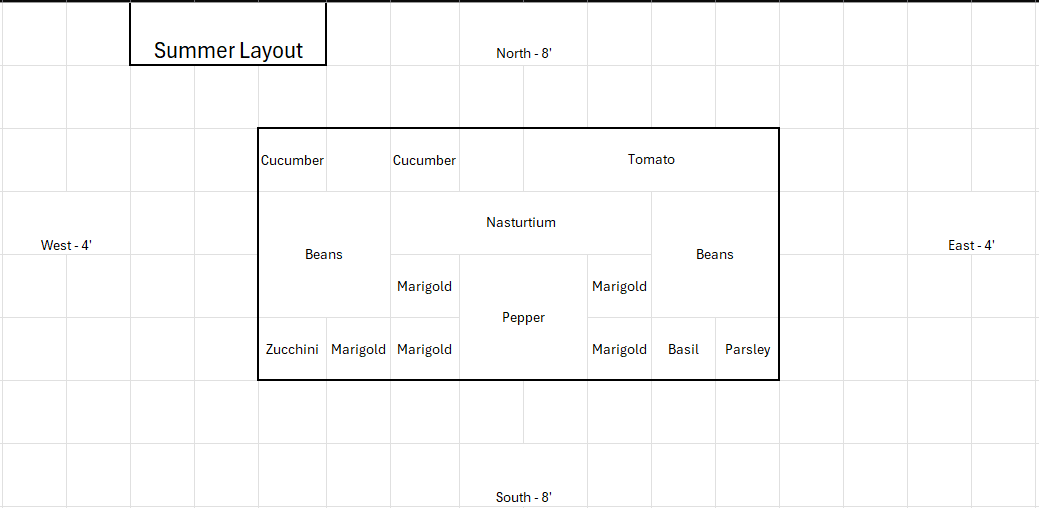
In this scenario, I’d use dwarf French marigolds, and plant 2 or 3 per allotted square and then sneak more in wherever I find gaps. Nasturtium likes to climb things when it can, and I’d let it climb up the trellis that I plan to use to support the cucumbers and tomato if it found its way there.
I would use a crossbar truss-like support that would reach at least 6’ above the bed height and extend east to west near the north side of the raised bed to trellis my vining plants.
For the cucumbers, I’d drape netting over the crossbar so the cucumbers can ascend using their tendrils. I’m choosing a pickling cucumber variety because, in my experience, they are inherently less attractive to cucumber beetles and are generally smaller plants. Plus, I can pickle the cucumbers if I have extra!
As for the tomato, I’d pick an indeterminate variety (e.g. Granadero, Amish Paste, Gilbertie) to extend the harvest through the summer and allow for more pruning and training. To support the tomato, I’d use eyehooks and rope/tie to connect the vine to the crossbar, a lot like I already do in my polytunnel.
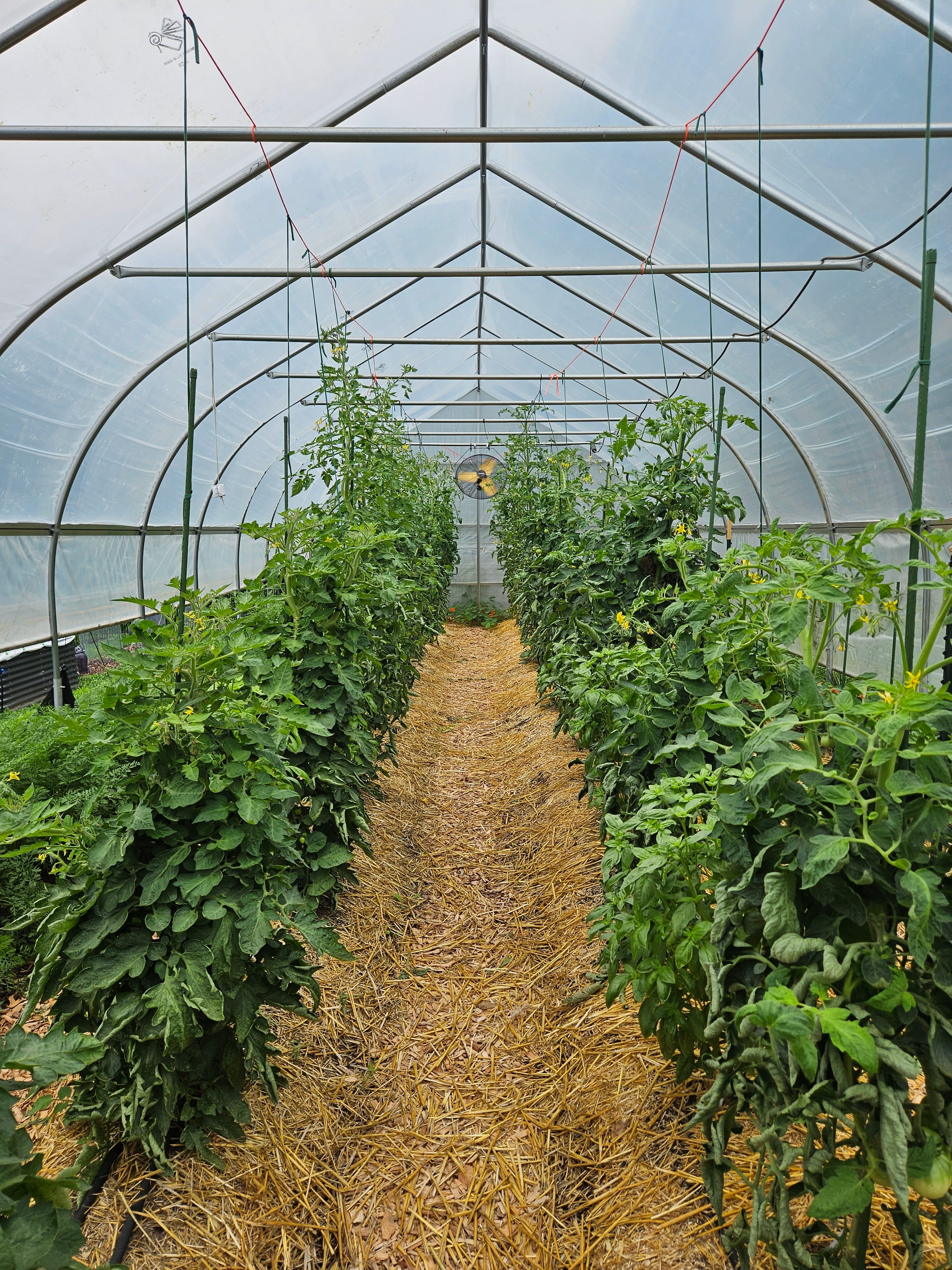
In this case, though, I’m only planting one tomato to give it plenty of room to grow suckers, but also enough space for proper airflow and sunlight penetration. More sun = more tomatoes.
As for my pepper, I’m picking a smaller but more productive pepper variety like shishito or jalapeno. With space for only one plant, I want to make sure I get a ton of peppers from it. A shishito or jalapeno plant can produce dozens of peppers over a single growing season, which is way more than a bell pepper plant could ever dream of. In addition, I’ve noticed in my garden that the smaller peppers tend to be more pest resistant, whereas the sweet peppers tend to attract pests that like to eat their fruit. I’ll plant that at the front of the bed and use a square cage to support it.
I’ve placed a zucchini near the edge of my bed. While zucchinis aren’t technically vining plants, you can grow them vertically on a stake. In my case, though, I’m assuming I can allow the plant to trail over the edge of the bed and onto the ground below. Zucchinis grow toward the sun, so it will naturally go in a southern direction. I couldn’t help but add this zucchini because, while it takes up a substantial amount of space, the output is very high. Plus, you can always trim the leaves near the bed edge if necessary to reduce how much it obstructs the sun for the plants near its base in the bed.
Finally, I’ll plant bush beans like the Compass variety around the bases of my vining plants, but behind the basil, marigold, and zucchini. Bush beans tend to grow about 16-20” tall on average, so they won’t block too much sun from the cucumbers and tomatoes, especially once they’ve really begun their ascent up the trellis in June. Green beans are a very high output-per-square-foot plant and are relatively low maintenance. I might even succession sow these every other week for three weeks to extend my harvest through the summer.
I love and use basil regularly, but one plant that is regularly pruned will be more than enough for me to enjoy all summer long. It’s taller (~24”) and might block some sun from the beans behind it, but the beans will be okay, especially those closer to the eastern edge of the bed. If needed, I can begin pruning it early in order to control its height.
Maximum potential output:
15 pounds of paste tomato
6 pounds of pickling cucumber
6 pounds of green beans
8-10 pounds of zucchini
2 pounds of peppers
Basil (pick through summer)
Parsley (pick through to fall)
Marigold and nasturtium petals
As September nears, most of my plants will begin to slow down and look worn. I’ll begin to remove the least productive plants to make room for my fall crops.
Fall (September to Frost)
For me, fall is exciting because I get to enjoy brassicas that are sweetened by the cold. With a ton of space, growing a reasonable amount of broccoli, cauliflower, and brussels sprouts is doable, but not in an 8x4’ bed. Instead, I’ll plant the smallest of brassicas, like turnips and pac choi, to get my fix.
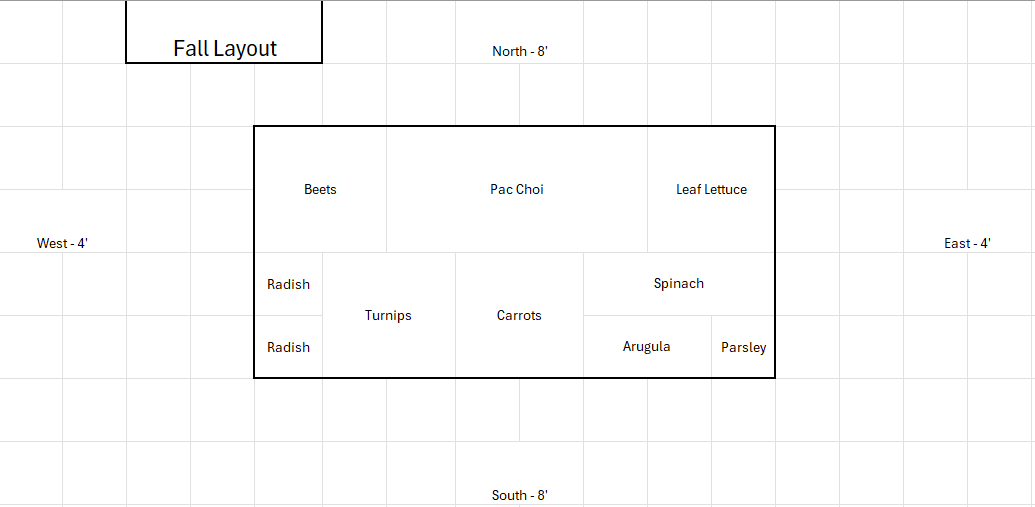
Like most other brassicas, turnips and pac choi take a good while to fully mature so it will be important to get those in the ground as soon as space shows up in the summer garden. I really only have 45 days to before my first expected frost date of October 15th, which isn’t too alarming for the pac choi as it can be eaten as baby pac choi.
However, my turnips may need to be snuck in early so I would consider removing some beans (perhaps those sown earliest in the succession) and marigold to make space earlier in the season.
Regardless, if the frost arrives early or on time, I would cover the entire bed with frost blankets.
Maximum potential output:
24-32 heads pac choi
4-6 heads Winter Density lettuce
30-50 beets
60-90 radishes
40-50 carrots
28-32 turnips
12-18 arugula plants
18-24 spinach plants
Parsley
I like to plant a little more densely as the temperatures decline. These numbers are, of course, the maximum number that could be planted given the square footage. That said, I would try to plant closer to the maximum than normal in the fall for each crop.
Insect pest pressure tends to decline along with the temperature, so slight crowding isn’t as dangerous (though airflow is still important!). Plus, I’ve noticed in my garden, denser plantings seem to tolerate light frosts better than those with big gaps.
In any case, thinnings can be eaten as well!
Winter
All the while as the season progresses towards the earliest fall frost date, I would be considering starting my winter greens indoors, hardening them outside, and then planting them in the gaps that start to show up in my fall bed.
To truly maximize the bed, I’d want to grow through winter if possible. In my climate, this would require a cold frame, which is a sort of mini-greenhouse you place over your plants to increase the air and soil temperature.
In reality, I would not take this step. I’d probably mulch my bed with leaves, compost and/or straw and let it rest for the winter, but I think it’s an important option to mention.
Beets, leeks, spinach, lettuces (like Winter Density or Red Oak Leaf), carrots, and kale are suitable for mild to moderate winter conditions and can be grown under a cold frame.
Alternatively, I could grow a cover crop that would be winter-killed to add biomass and improve my soil when the spring comes. Ideally, though, I’d want to start growing my cover crop before mid-October. Doing so would make it difficult to grow a fall crop. So, I would have to choose one or the other.
Final Takeaway
If I only had one 8x4’ bed, this is how I’d run it: quick spring crops, high-yield summer staples, a tasty root-forward fall bed (plus a winter rest). The point isn’t to grow everything. It’s to grow what you want to eat, most importantly, and what gives the biggest return in the space you have and with the time you have to manage it. One bed can produce a surprising amount of organic food when each season is planned with intention, and when empty space gets replanted quickly.
That’s just what I’d do. How would your bed differ? I’m very interested to hear, so please comment below what you’d change about my plan.
Yeah, but with such a nice summer season of over 4 months here, I'd get tired of the same veggies and crave something different hence the switch to fall crops. Of course everyone would manage it differently, which was part of the reason I specified this is just how I'd do it. There's no right way.
I picked paste over slicing tomatoes because they're more difficult to find around me locally and offer more canning options for the recipes I like to use.
I was considering peas in the spring but I didnt think I had enough space to get a big enough harvest to justify the use of space.
This is really fun because we picked most of the same plants but the differences are very distinctive and reflect the gardener personally. I love it!
Have you taken into consideration the crops sown after the summer solstice take two weeks longer to mature because the days consistently grow shorter? I think everyone would manage one bed differently, depending on what they like to eat. I would tend to prioritize crops that I can't get in good quality from the grocery store and not grow crops that store well and are typically fine from the grocery store. I wouldn't grow root crops or brassicas. I'd have heirloom slicing tomatoes, green beans, eggplant, parsley, cilantro, swiss chard, scallions, a couple of serrano plants, and zinnias. In the spring I'd have shelling peas. I'd keep the summer crops going until the killing frost and put the garden to bed, succession planting as needed. I'd keep my parsley, chard, and scallions under a little insect net.